The 2025-6 accounts for the UK APF are here. Compared to previous years, things are neither much better or worse: the large accounting loss remains and is slowly being crystallised by payments from the Treasury to meet the shortfall.
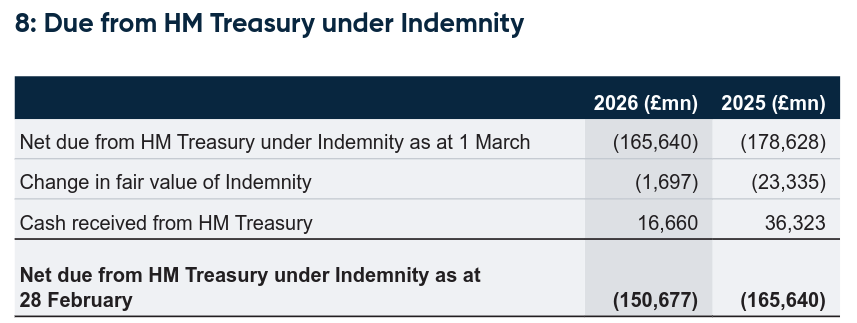
(from Bank of England Asset Purchase Facility Accounts 1 March 2025 – 28th Feb 2026)
The headline number there is the smallest: the “change in fair value of Indemnity” is the increase in losses on the bonds held in the APF at the start of this accounting year through to the end. Only a £1.7B loss this year, despite the continued upward pressure on interest rates. See my original post for a discussion of why the APF is roughly speaking a huge interest rate swap gone bad.
The Treasury paid in another £16.6B to cover the APF’s present losses — primarily the gap between interest paid on the bonds and interest owed on the loan from the BoE (ultimately paid out to the retail banks on their credit balances at the BoE).
Again, see my original post for an explanation of the losses from active sales versus holding to maturity.
The unrealised loss (the bill yet to be paid) has therefore decreased by ~£15B to £150B, as the Treasury’s payment to cover realised losses exceeds the increase in losses in the last year.
In the last 3 years, the Treasury needed to pay £44B (2023), £36B (2024), and £16B (2025) to the APF to cover realised losses. So the immediate pain for the Treasury has decreased a lot, albeit £16B per annum is still appallingly high. And there is still £150B total expected to be paid over future years at the current valuation.
One oddity stands out: the APF was holding £20B in cash at the end of the period from sales of bonds. So the APF is selling bonds but not using all of the funds to reduce its loan from the BoE, nor using the proceeds to cover loan payments (for which shortfall it is tapping the Treasury). This figure has been growing from year to year, and this is the first time that is had exceeded the funds requested from the Treasury.
Holding cash and not reducing the loan I imagine has no significant profit/loss implications — I assume the BoE offsets the positive balance off of the loan anyway, in effect offering the APF interest on its positive balance equal to the interest rate on the loan. But it is a little odd that the APF is asking the Treasury for money to cover the shortfall in interest payments when it could meet them out of cash on hand. It doesn’t affect the amount in total needed from the Treasury in the long run; but why hold money from redemptions rather than redeeming the corresponding part of the loan immediately if you are also not going to use it for paying interest? Those are the only two things that the APF uses received money for.