So, how is Strategy doing?
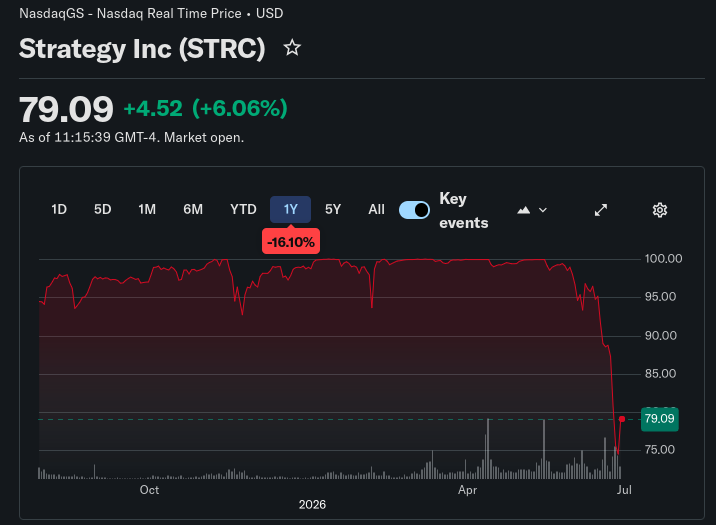
Not great — STRC (one of the preferred stocks issued by Strategy) is well below par and was falling fast. That is presumably why they have just announced their Digital Credit Capital Framework (SEC filing). So what does it mean?
USD Reserve Policy
Under the policy, the USD Reserve may be used only to support the payment of preferred stock dividends and interest expense on outstanding indebtedness. Any other use requires Board authorization.
This is a sensible statement; sitting on so much money as a reserve, it would not make much sense to allow it to be repurposed without the board approving the change. Still, that they needed to put that at the top of their announcement suggests that there was some real concern from holders of the bonds and/or preferred stock that Strategy might otherwise dip into the reserve intended to protect their dividends.
STRC Dividend Policy
Briefly, STRC is the preferred stock from Strategy that is in effect a floating-rate bond. It was meant to be pegged to around $100 (“SERIES A PERPETUAL STRETCH PREFERRED STOCK ANNEX”):
Our current intention [in 2025], which is subject to change in our sole and absolute discretion, is to adjust the regular dividend rate in such a manner as we believe will maintain STRC Stock’s trading price at or close to its stated amount of $100 per share. For example, if the trading price of STRC Stock exceeds $100, our current intention would be to reduce the regular dividend rate with the goal of causing the trading price of STRC Stock to decrease. Similarly, if the trading price of STRC Stock is less than $100, our current intention would be to increase the regular dividend rate with the goal of causing the trading price of STRC Stock to appreciate.
This is an interesting idea: a bond that discovers the current market rate to lend (indefinitely) to the company. The new framework says that instead:
…the Company intends to evaluate the STRC dividend rate monthly based on a range of factors, including STRC trading levels, market yields, credit spreads, the price and volatility of bitcoin, USD Reserve coverage, capital market conditions, and the Company’s overall capital structure.
That seems/seemed like a fancy way of saying that they would not increase the dividend any more. STRC had a nominal yield of 11.5% which is well into junk debt; its market yield was touching 16% before trading today (https://www.strategy.com/strc 2026-09-29 before market open). I found a reference saying that CCC-rated debt (“substantial risk” of default) today yields around 13-14% on average, so at 16% the market was saying that STRC was considered at worse than “substantial risk” of default.
So Strategy has (sensibly) tried to reassure investors further with their USD treasury (though the treasure already existed, for this purpose, and yet the stock was in junk territory).
But they did increase the yield one last time:
On June 29, 2026, Strategy announced that it will increase the regular dividend rate per annum on the Company’s Variable Rate Series A Perpetual Stretch Preferred Stock (“STRC”) effective for semi-monthly periods with record dates on or after July 1, 2026, to 12.00%.
At at 16% market yield, raising the yield further is not going to push the price up: people are pricing based on the risk of default. If the market considers the risk of default to be much less than 25%, it would not make much sense for STRC to trade at 75 cents on the dollar (before the announcement).
Their third move seems more useful:
The Company’s Board of Directors has authorized …sell[ing] bitcoin from time to time …
The Company announced that it has established a repurchase program for up to $1.0 billion aggregate purchase price of its outstanding Digital Credit Securities, including STRC, [and others]. The Company currently expects STRC to be the initial priority [for] repurchases.
Even if you think that bitcoin is going up 30% p.a. (as Strategy believes), paying 16% p.a. interest at market on your debt used to fund the bitcoin is (relative to the option of buying back the distressed debt instead) giving up more than half of the profit from that rise, which is very expensive capital.
STRC is trading above 80 cents on the dollar after the announcement, which makes sense. If Strategy can sell bitcoin without crashing the bitcoin market, it is not a distressed debtor at all — it can buy back the entire STRC issue at market advantageously if it is available at distressed values. $1B is enough to buy back more than 10% of the STRC issue at market, and they can authorise more buyback if that was not enough to improve the price.
Class A Common Stock Repurchase Program
Another relevant detail is that Strategy had been trading below the value of its bitcoin holdings for a few days. So:
The Company also announced that it has established a repurchase program for up to $1.0 billion aggregate purchase price of its class A common stock.
As I discussed in my previous post about Strategy, this is normal and sensible if Strategy is viewed as like a bitcoin ETF (or any type of asset fund). Selling BTC to buy MSTR can bring the price back into line with its holdings, allowing investors an exit at fair value.
How is STRD doing?
STRD is a perpetual non-convertible preferred stock, ranking below STRC and “junior to all existing and future indebtedness and other liabilities”. So this is one step away from equity. What does the market think?
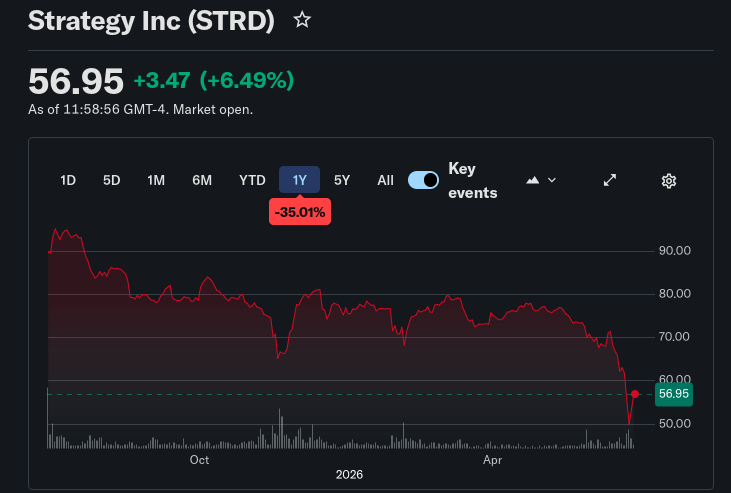
Prise $56.85 (against $100 par/redemption value), effective yield 17.65% (https://www.strategy.com/strd 2026-06-29 after market open). It was around 50 cents on the dollar before the announcement.
Trading at 56 cents on the dollar is seriously distressed debt, implying the market sees a large risk of default. You do not sell a company’s debt at 56 cents on the dollar if you think that the business is very likely to pay the dividends on time.
No wonder that Strategy’s “BTC Monetization Program” is authorised to buy back other securities — it again makes little sense to be paying 17% on its capital while buying bitcoin if it can instead buy back its debt at these distressed prices. Once again, Strategy has plenty of money on hand to buy back all of the preferred stock if it can sell its bitcoin without crashing the market; STRD only has a market cap of ~$800M at this distressed price so they could buy it all back right now (if they were not doing STRC first).
How about STRK?
Also grim. Effective yield 13.4%, trading at 60 cents on the dollar. Also nearly down to 50 cents on the dollar before today’s announcement.
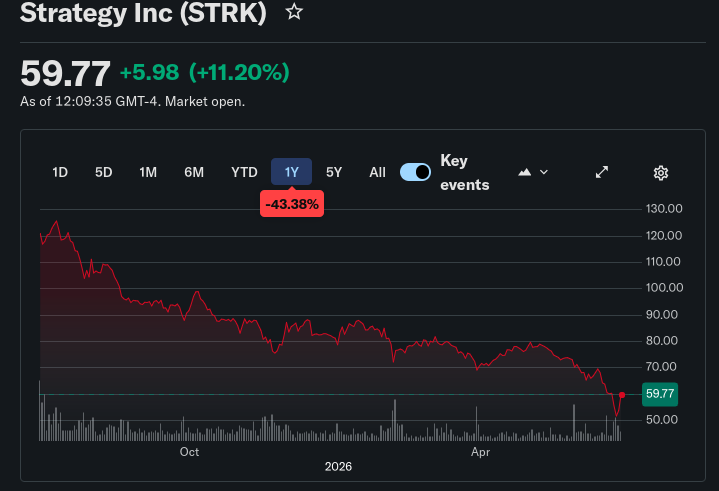
STRK is Strategy’s convertible preferred stock (issue filing), so trading significantly below par is not by itself a red flag: it only yields 8% nominal, and it likely could only be issued at that yield with the added lure of conversion if the common stock of Strategy did well. Right now it is not doing well.
But the high effective yield is around the level for a CCC bond, implying it is something that a bond desk thinks has a substantial risk of default.
On the positive side, the price bounced by 10% today with the news of the new framework. The market thinks that Strategy deleveraging is reducing the risk for STRC, STRD and STRK substantially.
How about STRF?
Effective yield 11.12% (https://www.strategy.com/strf 2026-06-29 after market open, up 6.6%).
STRF is senior to all of the other preferred stocks, junior only to the older convertible bonds and regular debts. 11% market yield is junk territory but not priced for a large risk of default. So the market thinks that Strategy probably has funds to pay out STRF even if STRC, STRD and the equity are all wiped out by losses — even if BTC crashes, in other words.
So the new strategy is selling bitcoin?
The Company’s Board of Directors has authorized a BTC monetization program (the “BTC Monetization Program”) under which the Company may sell bitcoin from time to time for three primary purposes: … (3) to additionally fund repurchases of Digital Credit Securities or class A common stock…
As discussed in my last post, for an asset treasury it makes sense to sell the asset and buy back stock if the market cap falls below the asset value — and Strategy’s common stock was below the value of its bitcoin briefly before the announcement.
Nevertheless this is an odd move for several reasons.
First, it is in general odd for a company that issued $1B of new shares last week to turn around and announce a potential buyback of common stock the next day. It would be normal enough for a bitcoin ETF or a fund trying to be like a bitcoin ETF; ETFs create and destroy shares all the time to maintain peg. But for a non-ETF asset investment fund it does look odd to heel turn like this. Did the accelerating drop in prices for all of Strategy’s preferred stocks push them into a sudden heel turn?
Second, as noted in my previous post, selling bitcoin goes against Saylor’s crypto evangalism and many statements that you should “HODL” your bitcoin. How investors are meant to parse a company where the chairman has made so many public posts contrary to the actual and pragmatic course for the business is baffling to me.
Third, selling preferred stocks, only to buy them back off the market at distressed values a short time later, is a lousy business model. It works out for Strategy now, but looks terrible to investors.
Are Digital Credit Securities Dead?
In a sane world, buying back Saylor’s “Digital Credit Securities” after less than two years at distressed values would kill the idea entirely. As an investor you are never happy to lend money and get paid back 60-70 cents on the dollar after not much time has passed (even if you agree to the tender). Doing so when the borrower is sitting on piles of money makes you even less happy, I imagine. Future investors will look at past investors happy to escape with only partial losses and should conclude that the idea was a failure. Bitcoin investors may view it differently, though.
If Strategy wants not to kill “Digital Credit Securities”, it should offer to pay closer to par for redeeming the preferred stocks. This makes it less good value, and means the loss on buying bitcoin last year and selling it now more painful. But if Saylor really believes in the “Digital Credit Securities” idea and thinks that it adds value in the long term, then it could seem worth it.
My own view remains that it is not worth it and that, if the investment premise of a rising bitcoin price is true, then buying bitcoin and holding would be better than these complex instruments.
Is Strategy toast?
The 5-10% bounce in strategy’s preferred stocks after the new “framework” announcement probably means that a lot of investors were truly unsure if Saylor was really willing to reverse the bitcoin buying. Most of the preferred’s are still priced as junk, of course, even after that rise, but today’s bounce is huge.
Even if the digital credit securities are a flop and get redeemed below par, while embarrassing for Strategy, the deleveraging could return it to being more like a simple bitcoin holding fund. If it holds bitcoin and sells and buys to maintain the value of its stock (relative to bitcoin), similar to a bitcoin ETF, that’s a fine investment vehicle. That is, if Strategy can redeem enough of the preferred stock without crashing bitcoin.
If Strategy can sell bitcoin without crashing the market, it should be able to redeem all its preferreds if it wants to. At their current valuations, it even makes sense to redeem a lot of them, since paying such a high cost of capital for debt does not make much sense for most businesses. Strategy is sitting on a mountain of funds; if it is not going to default then buying back debt at 60-70 cents on the dollar is likely profitable even if it sells bitcoin at a discount to its average purchase price to do it; if bitcoin is going to go lower and actual default is a possibility then selling bitcoin now to cancel debt improves its position.
From that I infer that the market has a real concern about the “if” there. I think that the market is pricing in a substantial chance that if Strategy tries selling bitcoin to redeem debt, the bitcoin price falls, and Strategy has to instead stop dividends on some of the preferreds and wait hopefully for a bitcoin recovery.
Even if that happens Strategy can default on all the preferred stocks (stopping dividends), and sell bitcoin more slowly to meet actual debt payments and running costs; its USD treasury gives it a useful buffer so it does not have to sell into a falling market provided its needs are moderate. Last year I argued that Strategy could always sell bitcoin to maintain the peg of its common stock to bitcoin (that is, to prevent a fall to less than the value of its holdings, if it cared to do so). I feel less confident about that now, since the market evidently thinks that the preferred stocks might not be able to be sustained at par even with a buyback programme, and those are senior to the common stock: if it defaults on the preferred, Strategy will not be able to buy back common stock. But I still think that Strategy has enough flexibility (by halting preferred dividends), and the bitcoin market is deep enough, that it ought not to fail just due to normal swings in the bitcoin price or even due to modest feedback from its own bitcoin sales. Unwinding the leverage could be slow and messy if it comes to that, but that is not in itself fatal; only bitcoin crashing and staying at depressed levels for years ought to ruin it.
I still think that just buying bitcoin is better if you believe in the investment premise, however. That looks even clearer with Strategy trading at roughly the value of its bitcoin: the magic of issuing shares to buy bitcoin to add value is over.
This is not personal financial advice. I have no position in any of the securities mentioned.